

Printable Checklist For Moving Parents To Assisted Living

Most moving checklists for relocating elderly parents to assisted living are written by the facilities themselves, and frankly, they are too basic.
The assisted living checklists tell you to bring medication, downsize, cancel utilities, and hire a mover, but they skip over the real moving advice you actually need. If you’re the adult child in charge, you already know to bring medication, transfer prescriptions, and pack the basics. What you actually need is the kind of logistical advice that assisted living facilities never bother to mention.
For your convenience, we created a concise, downloadable, and printable assisted living moving checklist PDF below. You can click the link, download it, and follow the tips. However, we recommend reading this entire article before doing so. Our printable checklist serves best as a reminder of what to do, and this page has a deeper breakdown of the critical logistics you need to know.
Phase 1: Coordinating Move-in Date & Time With Facility
Assisted living facilities have strict rules for movers to protect residents and the building. If you ignore these, your movers might not even get through the door. This is one of the most important steps to get right, or your entire move could fall apart before it starts.

Certificate Of Insurance (COI)
Interstate moving companies are required to provide a COI to the building, which is basically proof of insurance. The standard general liability limit is $1 million, which covers accidental property damage while movers are working in the building.
Asking Your Movers For COI (Urgent)
When you ask your movers for a certificate of insurance, they should know exactly what you mean. A COI is a simple one-page document that proves they have general liability, workers' compensation, and auto liability. If your movers cannot provide this, they will be turned away at the door, and your furniture will not make it inside.
Scheduling Delivery With Building And Movers
Assisted living facilities are strict about when movers can work. Some do not allow movers in the building past 5:00 pm, and others will not let them in the home on weekends at all.
Get A Guaranteed Delivery Date and Time With Movers (Priority)
Because most assisted living facilities do not allow movers on weekends or after 5:00 pm, you need a long distance moving company that can guarantee a specific delivery date and time.
Most long distance movers cannot do this, but a few, like American National Movers, can
⚠️ Must Know:
A guaranteed delivery date usually means you need a dedicated truck, and most interstate movers do not offer this. The few that do will charge an extra fee of around $2,500, bringing your total to about $6,500. If you agree to a dedicated truck and guaranteed delivery, get it in writing so the movers are legally required to honor it.
Reserving the Elevator For Movers (High Priority)
Your moving company cannot simply deliver your belongings on any day. You need to reserve the loading dock or freight elevator with building management. Movers are usually required to use the loading dock or back service entrance, not the main lobby.
Reserving The Service Elevator In Advance
Most assisted living facilities have multiple floors, so you will need to reserve the service elevator in advance. The building will provide the elevator for your movers, who usually get a 3-hour window. After 5:00pm, you cannot reserve the elevator. If your movers are late, they might not be allowed in the premises.
Phase 2: Understanding Furniture Restrictions and Room Layouts
When moving a senior to an assisted living facility, it is not just scheduling and less square footage you need to consider. You will also deal with strict facility safety codes that ban certain furniture items from being moved in.
ADA Compliance And Clear Walkways

Common Furniture Items Banned By Assisted Living Facilities
Assisted living apartments are designed with mobility and safety in mind. As a result, facilities ban many common household items such as bulky furniture. Do not pay movers to transport heavy items, or the facility will ask them to dispose of the items upon arrival.
⚠️ Throw Rugs and Runners: These are considered trip hazards for seniors using walkers or canes and are universally banned in adult homes.
⚠️ Oversized Items and Deep Sofas: Bulky seating can block the required 36-inch clear turning radius for wheelchairs.
⚠️ Glass Top Tables: Coffee tables, dining tables, or nightstands with glass tops pose a shattering risk and are banned in assisted living facilities.
⚠️ Furniture on Wheels: Items that slide unexpectedly are a safety hazard and are not allowed in homes.
Getting A Copy Of The Floor Plan
Assisted living facility rules can be rough, but their homes and communities can be a beautiful change for your elderly parents. To make the transition easier, get a copy of the floor plan so you can map the dimensions and decide what furniture to take.
Remember the 36 Inch Radius Rule
When furnishing the room, you must leave a 36-inch-wide pathway throughout the apartment. This means measuring at least 36 inches from the edge of a piece of furniture to the opposite wall or between two pieces of furniture. This ensures walkers and wheelchairs can pass without issues. If a bulky item, such as a bed or dresser, shrinks the walkway to less than 36 inches, it will not be allowed into the building.
Phase 3: Mandatory Debris and Box Removal
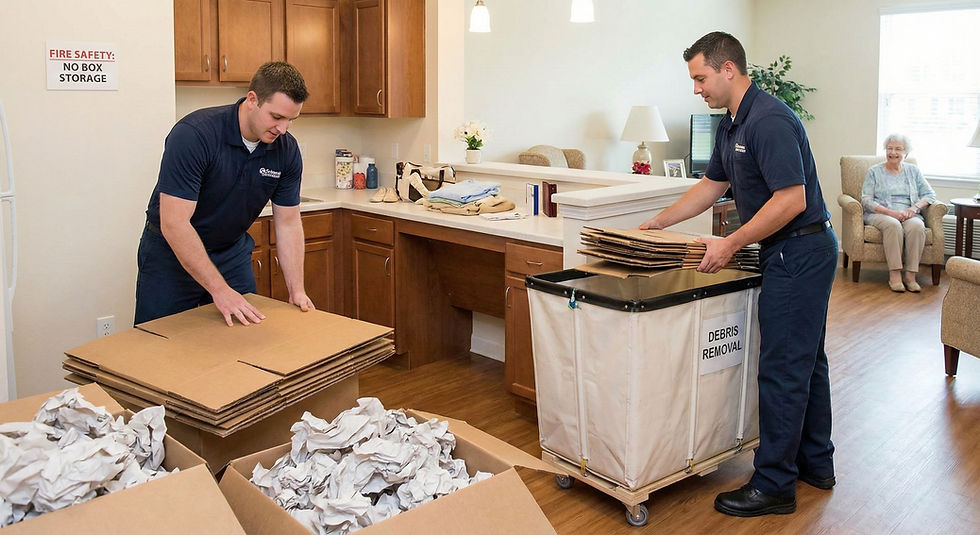
In a standard home, you can leave your boxes packed and unpack them later; in an assisted living facility, you can’t. Assisted living facilities view 30+ unpacked boxes and debris as a fire hazard and a tripping hazard for residents.
Require Unpacking Services From Your Movers
Do not let the movers drop off your boxes and leave. Your contracted agreement with your movers must include unpacking services and debris removal. The movers must unpack the boxes, place the items safely on counter tables, and physically remove all empty boxes and packing paper from the facility before leaving the building.
Phase 4: Managing Leftover Furniture & Moving Day Execution
Once you agree on which furniture to take to the facility, your next step is to figure out what to do with the rest. Then you need to manage contracts with movers and have a plan for who is legally allowed to handle moving contracts and other documentation.
Preparing For Split Delivery If Applicable
Sometimes, seniors may want to store furniture at a storage facility or in another home rather than sell it. These items have significant sentimental value, and a senior may refuse to move to an assisted living home if it means throwing away or selling most of their items.
Ask Your Movers To Do 2 Deliveries.
Though this may be a bit more costly, having 2 drop-offs (split delivery) can be done. Keep in mind that if your second delivery is significantly farther from your first stop, you will be charged a higher rate for this service.
Signing Bill Of Lading (Urgent)
Interstate moving companies are federally required to provide seniors and other consumers with a bill of lading. If your They will ask the or someone managing the move on their behalf to sign the Bill of Lading and give a copy. A Bill of Lading is an agreement between the carrier and the customer, serves as proof of service, and includes terms and conditions and payment terms.
What Is A Bill of Lading?
A Bill of Lading is an agreement between the carrier and the customer and serves as proof of service, including terms and conditions and payment terms. Be sure to sign and get a copy of your Bill Of Lading contract prior to the movers departing to the assisted living facility.
If Applicable The Power Of Attorney Must Be Present
If your parents are suffering from cognitive decline, Alzheimer's, or dementia, they legally cannot sign the Bill of Lading. In that case, the adult child or the power of attorney must be present to sign the Bill of Lading in person or electronically.
Phase 5: Preventing” Transfer Trauma” On Moving Day
Medical professionals recognized transfer trauma as a diagnosis in 1992. Transfer trauma is accompanied by a cluster of physical and mental symptoms that happen when a senior is moved from one state to another or to a new home, like an assisted living facility.
Keep Your Elderly Parents Away From The Physical Move.
If possible, it’s best to keep senior citizens away from the moving process. You can do this by relocating them to a home near the assisted living facility while they wait for the movers to arrive. Or by keeping your parents with a family member while the movers load the truck.
Wait Until Movers Arrive Before Moving Parents In.
During the relocation process, do not have your parents wait in the facility with their furniture. Do not move your parents in until the movers arrive with the furniture. When your parents
walk into their new home, it shouldn’t be empty — it should instantly look and feel like home.
Phase 6: The Final Administrative Checklist (The Basics)
Since we promised a complete checklist, here is a quick rundown of the essential healthcare and administrative tasks you need to check off before moving day:
Detailed Breakdown
Medical Clearances: Ensure your parent's primary care physician has signed the facility's required medical evaluation (most facilities require a negative TB test or an updated physical within 30 days of move-in).
Prescription Transfers: Find out whether the assisted living facility requires you to use its in-house pharmacy, and transfer all prescriptions before moving day.
Change of Address & Utilities: Set up USPS mail forwarding, cancel the old home's utility services, and update your parents' address with the Social Security Administration, Medicare, and their bank.
Label Everything: Facilities wash clothing in communal laundries. Use a fabric marker or iron-on tags to add your parents' initials to every piece of clothing and bedding to prevent items from getting lost.
The Legal Binder: Create one physical folder containing the Power of Attorney (Medical and Financial), DNRs (Do Not Resuscitate), advance directives, and insurance cards. This stays with you in your personal car on moving day, never on the moving truck.
Frequently Asked Questions
Below are frequent questions adults ask when relocating their aging parent’s to assisted living facilities.
How Far In Advance Should I Contact The Facility To Reserve The Elevator and Schedule The Move in Date?
You should contact building management for the move-in date as soon as possible. With reserving the elevator, assisted living facilities ask that you reserve it within a week of your movers move in date.
How Do I Find Reputable Movers Who Offer Guaranteed Delivery Services?
Long distance movers guaranteeing your delivery date is rare, but reputable brands like American National Movers offer this service for an added fee.
What’s The Best Way To Decide Which Furniture To Keep, Store, or Donate?
Start by requesting a floor plan and the "banned items" list from the facility director. Immediately rule out banned items. Next, measure your parents' favorite, most familiar pieces to ensure they allow for the mandatory 36-inch clear walkways. Keep the items that make the space feel like home, and ask your moving company about a split delivery to transport leftover sentimental items to a storage unit or a family member's house.
Do My Parent’s Need To Sign The Paperwork Or Can I Sign It For Them?
With your parents' permission, you may be able to sign the bill of lading and estimated contracts. You must be physically present to sign the moving company's Bill of Lading or be willing to sign the documentation electronically. If you sign the moving contracts electronically, be prepared to send over identification to verify the signature.
How Can I Help My Parent Cope Emotionally With The Move and Reduce Transfer Trauma?
The most effective way to minimize Relocation Stress Syndrome (transfer trauma) is to maintain environmental familiarity. Try to arrange their bed, nightstand, and favorite chair in the exact same orientation as their old home. Furthermore, keep your parents away from the chaos of the physical move. Require your movers to provide full unpacking and debris removal services so your parent walks into a finished, welcoming home, not a room full of boxes and unpacked items.
American National Movers, A Assisted Living Relocation Specialist
American National Movers provides assisted living moving services for consumers in Austin, Texas, Florida, Georgetown, Lakeway, Cedar Park, Round Rock, and Beyond. We are a national moving service with trained movers that specialize in assisted living moves and senior long distance relocations.
For seniors, we discount our hauls by up to 25%, and our senior moving services generally cost $6,500 with a guaranteed delivery date. For seniors, many assisted living moving companies charge an average of $8,000 or more. With American National Movers, you get a reasonable rate and an exceptional moving service for seniors.
Related Articles:

Comments